 AI Generated
Every restaurant owner eventually asks the same question when a camera vendor calls: is this actually worth the money? For an industry running on thin margins, restaurant security system cost can look like an unnecessary line item — until you count what a single unnoticed theft, a missed hygiene violation, or a health inspection failure actually costs. The real comparison isn't cameras versus no cameras. It's basic recording versus a system that actively catches problems before they turn into losses. That's the gap Restaurant Video Analytics is built to close.
What You're Actually Paying For
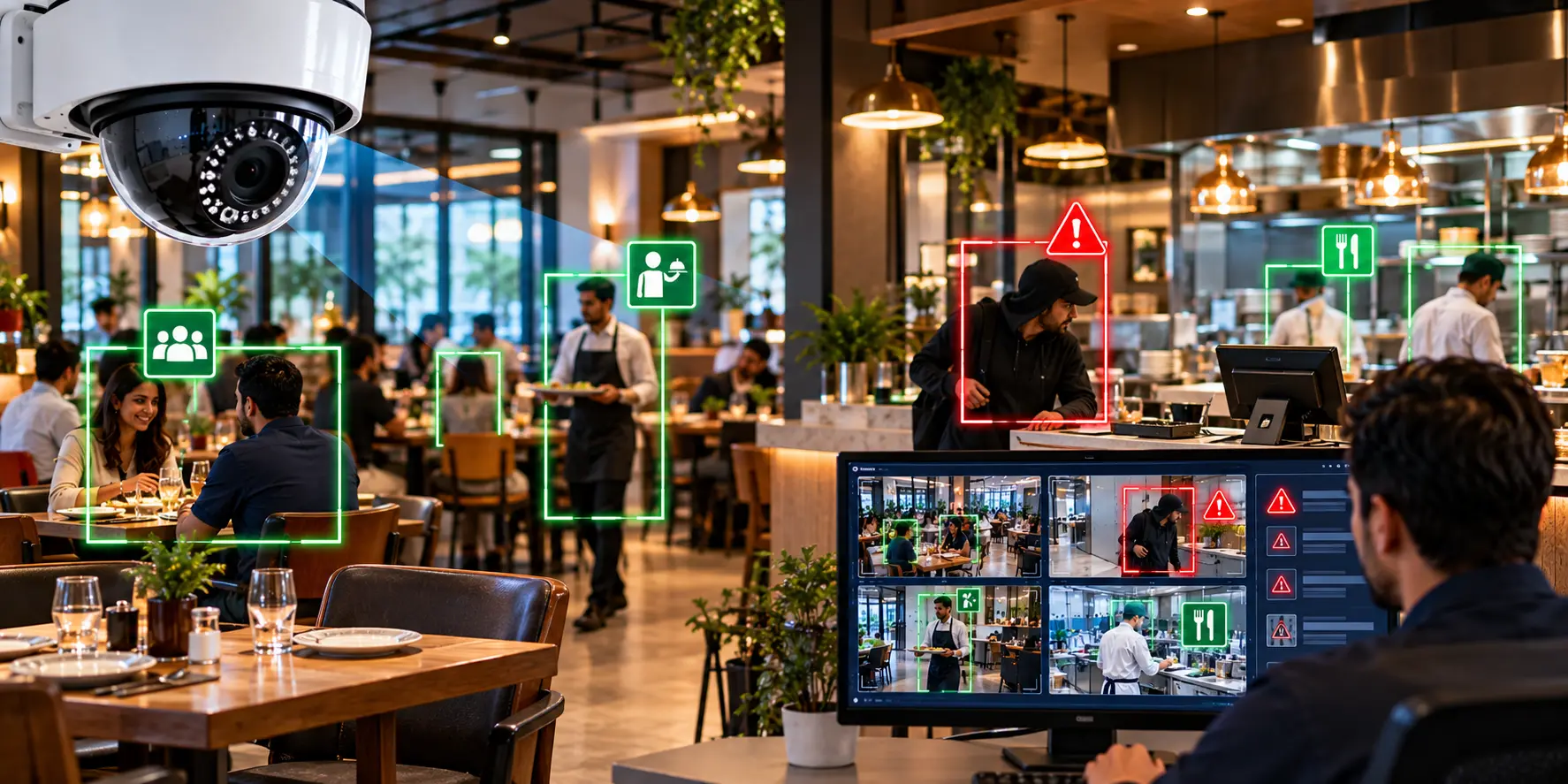
Most restaurants already have CCTV. What they don't have is anyone watching it. A Restaurant Security System built on AI analytics doesn't add more cameras — it adds a layer of continuous interpretation on top of the cameras already installed. Per the process laid out in How It Works, the system connects to an existing CCTV NVR, gets configured with business-specific rules, and then monitors, detects, and alerts continuously — no additional hardware investment required to get started, which is a meaningful factor in the overall cost equation.
This matters for cost-conscious owners because the biggest expense isn't the AI layer itself — it's whether an outlet needs to replace its camera infrastructure to use it. In most cases, it doesn't.
The Real Cost Driver: Camera Count, Not Complexity
Restaurant security system cost scales primarily with two things: how many cameras need monitoring and how many locations are involved. A single kitchen with a handful of entry points and a billing counter has very different requirements than a five-outlet chain running dozens of cameras across the city. Under Product Variants, a compact AI device supporting up to 6–7 cameras is positioned specifically for restaurants, retail stores, clinics, and small offices — built to be cost-effective and quick to deploy for exactly this single-outlet scenario. Chains operating at larger scale would instead need the industrial-grade variant designed for 8+ cameras and multi-site deployments, which is a different cost bracket entirely. Because the right fit depends on the specific outlet layout and camera count, the only accurate way to get a number is to request a demo and quote rather than rely on a generic price estimate.
What You Lose Without It — Proven, Not Theoretical
The clearest way to judge the value side of this comparison is to look at what advanced analytics catches in practice, not in a sales pitch. The Live Detection page documents two unstaged examples from an actual kitchen: a staff member without required headgear flagged automatically at 2:51 AM during a routine SOP/PPE check, and a rodent identified and boxed with 88% confidence during a pest scan at 8:00 AM — captured on night-vision footage a human reviewer would likely have scrolled past.
Neither of those events would typically surface until a customer complaint, a failed inspection, or a health department visit — each of which carries a far higher cost than the system that would have caught it in the moment. This is the actual cost comparison worth making: not "camera vs. no camera," but "caught in seconds vs. discovered after the damage is done."
Where Restaurant Video Surveillance Systems Pay for Themselves
Three areas typically decide whether restaurant video surveillance systems justify their cost for a given owner:
Shrinkage at the till and storeroom. Configurable alert rules around billing counters and back-entrance storage areas catch the slow, incremental theft that rarely shows up until a stock count comes up short, as outlined under Key Features.
Multi-outlet oversight without extra headcount. A centralized cloud dashboard lets one operations manager monitor every location's alerts and daily reports from a single screen — replacing what would otherwise require a supervisor physically present at each outlet.
Compliance documentation. Automated daily reports create a timestamped record of hygiene and SOP monitoring across every shift, which matters as much for demonstrating due diligence during an inspection as it does for catching the violation itself.
Restaurant Video Analytics Solutions for Chains vs. Single Outlets
The value equation shifts depending on scale. A single restaurant weighing restaurant video analytics solutions is mainly buying protection against theft and safety lapses at one site. A food chain is buying something additional: consistency. Multi-site monitoring means the same PPE and hygiene rules get enforced identically whether the outlet is across town or across the state, with every violation logged the same way and visible on the same dashboard — a level of standardized oversight that manual manager check-ins simply can't replicate at scale.
Uptime Is Part of the Cost Calculation Too
A system that stops working the moment the internet drops isn't delivering the value it was bought for. On-premises video processing keeps detection running through connectivity outages, syncing alerts and logs automatically once the connection returns — meaning coverage doesn't lapse during a busy dinner service just because the router did.
The Bottom Line
Weighing restaurant security system cost in isolation misses the point. The real question is what a missed theft, an unflagged hygiene violation, or a failed inspection would have cost instead — and whether an owner would rather find out about a problem from a real-time alert or from a customer review. Advanced Restaurant Video Analytics is priced around camera count and outlet scale, not a flat fee, which means the fairest way to judge the investment is against an accurate quote for a specific setup. Get in touch for pricing based on your actual outlet size and camera count.
FAQs
No. Cost scales with the number of cameras and the scale of deployment — a single outlet with a handful of cameras falls into a different bracket than a multi-location chain running dozens of cameras, so an accurate figure requires a quote based on the specific setup.
No. The system connects directly to an existing CCTV NVR and IP cameras, so restaurants can add AI-driven analytics on top of infrastructure they already have.
Documented real-world detections include a staff PPE violation (missing headgear) flagged automatically during a night-shift check, and a rodent identified and boxed with high confidence during a pest-activity scan — both caught instantly rather than during a later footage review.
For a single location, a compact device supporting up to 6–7 cameras is specifically built to be cost-effective for restaurants and small food outlets, making the investment proportional to a smaller footprint rather than requiring enterprise-scale infrastructure.
Chains gain centralized, standardized oversight — the same SOP and hygiene rules enforced identically across every location, with all alerts and reports visible on one shared dashboard instead of relying on separate manual checks at each site.
Your cameras already see everything. Patrol makes them understand everything.
Transform surveillance footage into actionable intelligence. Receive real-time alerts, ensure SOP compliance, and protect people, assets, and reputation.